ui engineering
CrUX now shows an experimental soft-navigation view for SPAs
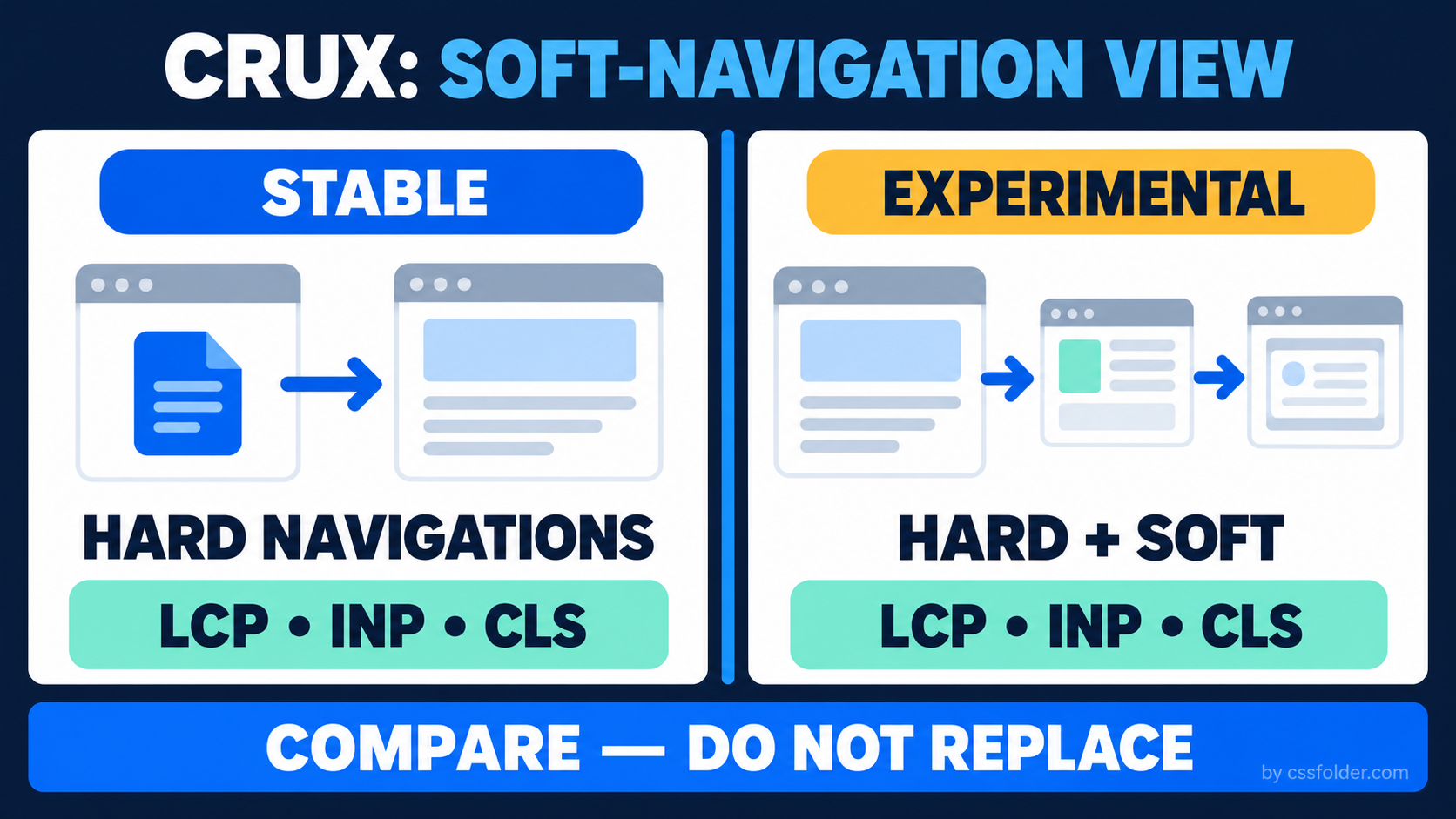
CrUX now exposes experimental LCP, INP, and CLS fields that include SPA soft navigations, so teams can compare a route-aware view without replacing their stable Core Web Vitals reporting.
Published 2026-10-19

Single-page applications have always made one part of field performance reporting harder to read: a visitor can move between several URL-backed views without triggering a new document load. In its October 2026 release, the Chrome User Experience Report (CrUX) added experimental versions of Largest Contentful Paint, Interaction to Next Paint, and Cumulative Layout Shift that include those soft navigations. The new fields are a useful extra lens for SPA teams, but they are not replacements for the existing Core Web Vitals series.

What the experimental view adds
A soft navigation is a client-side view change that updates both page content and the URL without loading a new HTML document. Before this release, CrUX focused on the initial hard navigation for that journey. Subsequent SPA view changes were not reported as separate navigations; interactions and layout shifts could instead be associated with the broader session. The experimental series reports those transitions alongside hard navigations, giving teams a more route-oriented way to inspect the same three user-experience dimensions.
The fields are named experimental_largest_contentful_paint_with_softnavs, experimental_interaction_to_next_paint_with_softnavs, and experimental_cumulative_layout_shift_with_softnavs. They are available in the CrUX BigQuery dataset, CrUX API, and CrUX History API from the October 2026 release. The long names matter because they make the relationship explicit: this is a parallel, labeled experiment, not a silent change to the familiar LCP, INP, or CLS fields.
Why an SPA dashboard may move
A route transition often reuses code, data, and visual assets from the initial page. When those faster follow-up views join the measurement set, an SPA’s experimental LCP can look better than its hard-navigation-only LCP. INP and CLS can also shift because the experimental approach segments them by individual view rather than allowing a long session to dominate the result. That does not prove that the app got faster, and it does not erase route-transition work that still blocks the main thread or shifts layout.
The change will not be equally visible everywhere. web.dev says 66–75% of origins have fewer than 5% soft navigations. It also reports that only 7.0% of Android origins and 10.6% of desktop origins have more than half of their page views as soft navigations. Teams with a conventional multi-page site should expect little or no difference; SPA-heavy products are the ones most likely to see a useful new perspective.
Compare first; do not replace reporting
Google says stable Core Web Vitals scores remain unchanged while the experimental metrics are evaluated. Keep alerts, SLOs, historical charts, and stakeholder reports on their current stable series unless your organization deliberately adds a second view. A good first dashboard change is a labeled comparison: display the established metric beside its experimental soft-navigation counterpart, with the scope and date range shown clearly.
Stable CrUX fields: LCP, INP, CLS
Experimental parallel fields: *_with_softnavs
Interpretation: compare the series before treating a delta as a performance change
For an eligible SPA origin, compare the two series across a consistent period, then review whether the routes people use most often are actually soft navigations. Pair that aggregate read with your own route-level RUM and traces. If the experimental LCP improves but an important transition still feels sluggish, inspect the route’s rendering and main-thread work rather than assuming the aggregate shift resolves the product issue. Conversely, a stable-looking initial load does not describe every in-app view a visitor sees.
A cautious next step for frontend teams
Start by inventorying whether your router changes content and URLs without full loads, and whether those transitions matter to core journeys. Add the experimental fields to an internal exploration dashboard; do not blend them into a single trendline with the stable metrics. Document that any observed change can reflect a different measurement boundary as well as a different user experience. That small discipline will help a team learn from the new CrUX data without unintentionally rewriting its baseline.
The release is intentionally still experimental. web.dev anticipates additional experimental navigation-type and First Contentful Paint metrics in November, and says the current set is aimed for graduation in May 2027 subject to feedback. Treat the October release as an invitation to calibrate your observability, not as a deadline to change production targets.