browser features
SVG 2’s new Candidate Recommendation is a cue to check your graphics pipeline
W3C’s updated SVG 2 Candidate Recommendation is a useful prompt to test real graphics workflows—not a universal browser-support announcement.
Published 2026-10-07

W3C has published an updated Candidate Recommendation Snapshot of SVG 2. That status matters, but it is easy to read too much into it. A Candidate Recommendation is not a browser-release announcement and it is not a W3C Recommendation. It is a standards-track snapshot intended to gather implementation experience. For teams that create, optimize, or render SVG, the useful response is not a rushed rewrite. It is a good moment to make the graphics pipeline easier to test and reason about.

What changed: a fresh standards snapshot
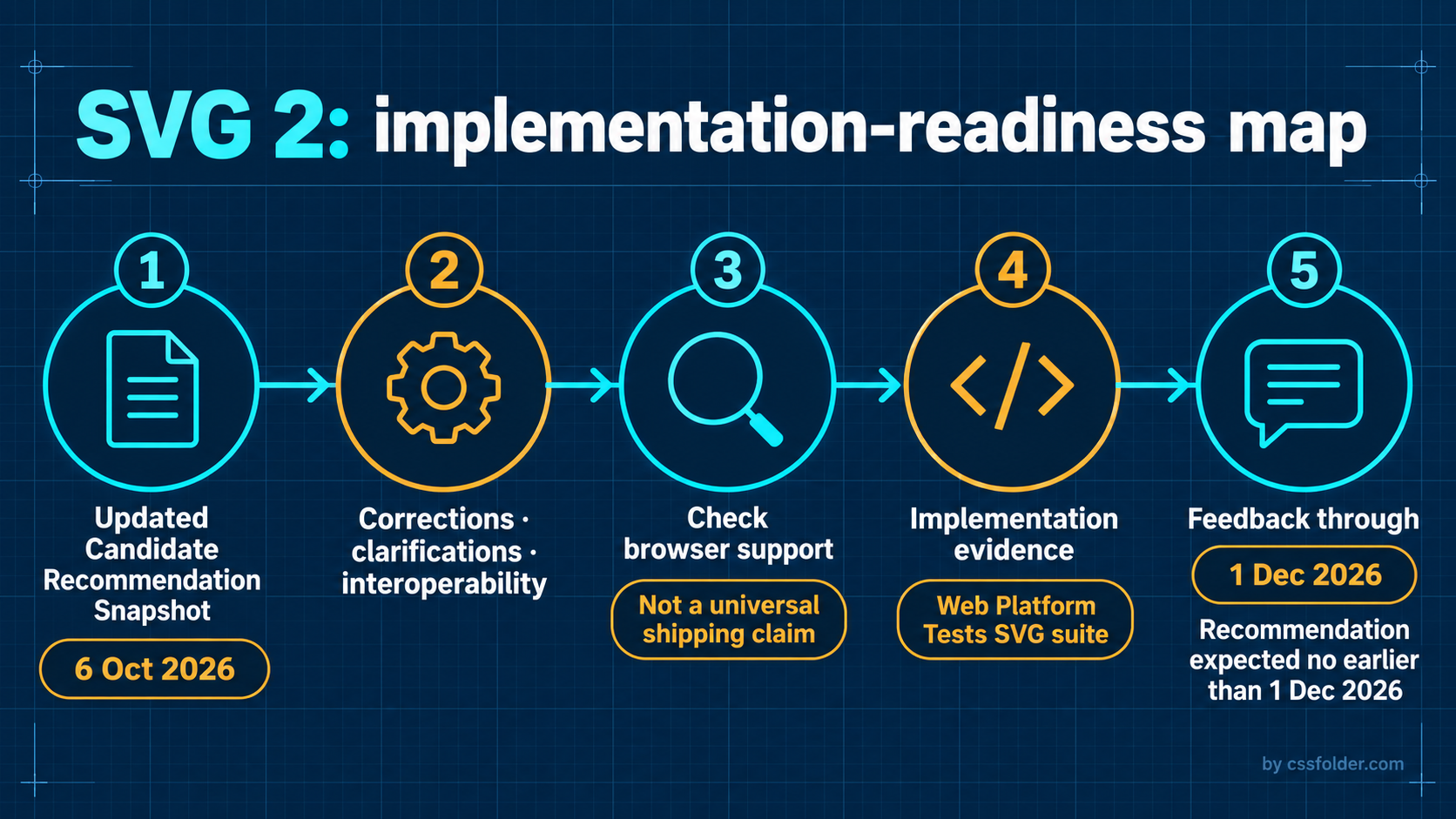
The SVG Working Group published the update on 6 October 2026. W3C describes it as a version with corrections, clarifications, and interoperability improvements, particularly for browser implementations. SVG 2 covers a broad language for two-dimensional vector and mixed vector/raster graphics: content can be styled, embedded alongside HTML, and changed with script or animation. That breadth is exactly why the document should not be compressed into a single support claim.
The snapshot gives implementers and authors a stable point to review, compare, and report against. It does not, by itself, make every described feature available in every browser. A design system should therefore keep its browser-support decisions tied to the exact SVG feature it needs, the browser versions it supports, and the way the asset is embedded.
Candidate Recommendation means implementation evidence matters
W3C’s SVG 2 document says Candidate Recommendation publication does not imply endorsement by W3C or its Members. The stage is meant to collect implementation experience. The specification also says an implementation report will be produced using the SVG suite in Web Platform Tests. In practical terms, the valuable signal is evidence: do implementations agree on observable behavior, and are edge cases covered by tests?
That is a useful lens for product teams too. When a vector asset behaves differently in an inline document, an image element, a CSS background, or an icon component, treat the embedding mode as part of the test case. A rendering difference is not always a design-token issue, and a successful local preview is not the same as a cross-browser result.
A low-risk review for frontend teams
Start with the SVG you already ship. Identify where it enters the product: hand-authored markup, exported illustration files, a component library, a build-time optimizer, or a CMS. Then collect a small representative set: icons with inherited color, assets using viewBox scaling, illustrations with text, and anything that relies on masking, clipping, filters, or animation. The goal is not to adopt “SVG 2” as a switch. It is to know which capabilities matter to your product and which are merely present in source files.
For each representative asset, test the supported browser matrix in the same context users see. Keep accessibility checks in that pass: meaningful inline SVG needs an appropriate accessible name, while decorative artwork should not become noisy output. Also confirm that optimization has not removed IDs or references needed by use elements, masks, or labels. The Candidate Recommendation is a sensible prompt to make those checks repeatable, not a reason to replace a working fallback.
Keep markup simple while support is verified
Portable SVG still benefits from conservative authoring: a complete viewBox, explicit dimensions or CSS sizing rules where appropriate, and a fallback plan when a visual is essential to comprehension. For a decorative inline icon, a compact pattern can remain both clear and testable:
<svg viewBox="0 0 24 24" aria-hidden="true" focusable="false">
  <path d="M4 12h16" />
</svg>
This is not an SVG 2-specific recipe. It is a reminder to test the markup you actually deploy, rather than assuming a standards milestone changes every user agent at once. When an asset needs a label or carries functional meaning, provide that name through the surrounding control or through the SVG’s own accessible markup according to the component’s semantics.
The next milestone is feedback, not an automatic deadline
W3C welcomes comments through 1 December 2026, and the specification says SVG 2 is expected to advance to Recommendation no earlier than that date. Those dates describe the standards process, not a forced migration date for websites. The practical opportunity is calmer: record real compatibility findings, improve a graphics regression suite, and report a focused interoperability issue when the evidence is reproducible.
Primary source
W3C, “Updated Candidate Recommendation: Scalable Vector Graphics (SVG) 2,” published 6 October 2026: https://www.w3.org/news/2026/updated-candidate-recommendation-scalable-vector-graphics-svg-2/